
The trust gap leaders rarely see

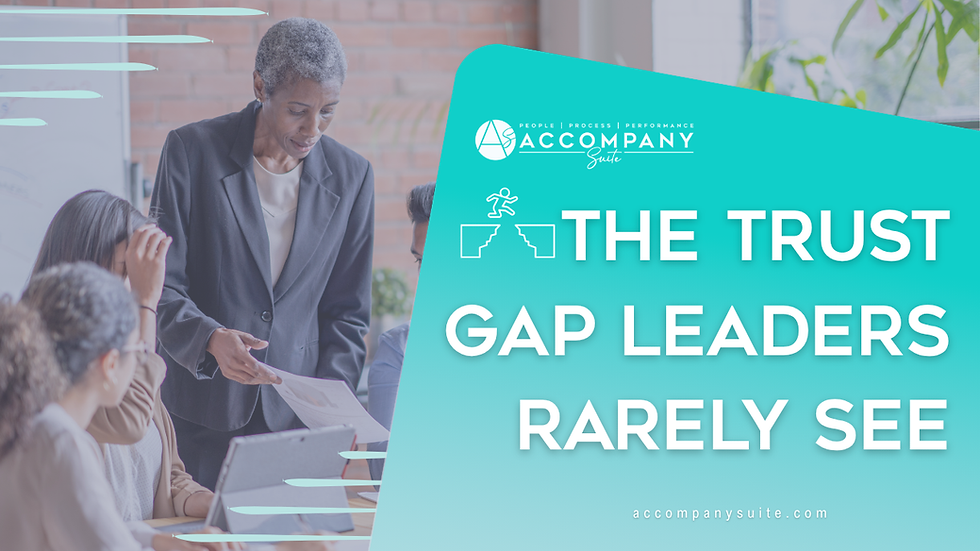
Most leaders believe their teams trust them, few know for certain.
Do you know the answer to this question…
If someone on your team strongly disagreed with you, would you hear about it immediately?
Or would you hear about it later… after the hallway conversations, the frustration, and the quiet workarounds had already begun?
That question reveals more about trust inside an organization than most engagement surveys ever will.
"Trust is revealed by how safely people can tell the truth."
-Kristine Goebel
The Trust Gap Is Wider Than Leaders Think
Many executives assume trust is strong inside their organization. Recent research suggests leaders may be way more confident about trust than the people experiencing the culture every day.
According to PwC’s Trust in Business Survey, roughly 90% of executives believe customers highly trust their companies, yet only about 30% of consumers report that level of trust. That represents a 60-point perception gap, larger than in previous years.
A similar gap exists internally.
Around 86% of executives believe employees trust their organization, while about 67% of employees say they highly trust their employer. Employees report higher trust than consumers, but the 18-point gap between leadership perception and employee experience is still growing.
The takeaway is that trust is easy to assume and harder to observe accurately.
The place where trust becomes most visible is conflict.
Read more about PwC’s survey: https://www.pwc.com/us/en/library/trust-in-business-survey.htm
What CEOs Notice When Trust Is Weak
From a CEO’s perspective, trusted relationships are not simply about morale.
They determine how well the organization actually functions.
When trust is weak, three risks appear quickly:
Information gets filtered. People edit what leaders hear. Concerns are softened. Problems surface late. Opportunities remain unspoken. Leaders then make decisions with incomplete information because the environment does not invite candor.
Unproductive conflict. Avoided conflict is dangerous to all relationships.
When disagreement cannot be addressed directly, it often reappears in quieter ways: side conversations, passive resistance, delayed decisions, and growing frustration between teams.
Alignment weakens. Teams may appear aligned in meetings while privately pulling in different directions. People comply rather than commit. Questions remain unasked.
True alignment requires the freedom to disagree.
What Organizations Miss Without Trust
When trusted relationships are missing, organizations lose capability:
They lose speed, because problems surface late.
They lose clarity, because leaders operate with partial information.
They lose innovation, because ideas stay unspoken.
They lose accountability, because difficult conversations are avoided.
And they lose resilience, because pressure exposes fragile relationships.
Trusted relationships allow teams to confront problems together instead of quietly working around them.
How to Tell If Your Leadership Team Actually Trusts Each Other
Leaders often assume trust is present because their team appears respectful and cooperative. There are clearer signals.
You are likely surrounded by trusted relationships when:
Leaders challenge each other respectfully in meetings. Disagreement happens in the room, not after it.
Difficult topics surface early. Problems appear when they are still manageable.
Questions replace assumptions. People seek understanding instead of drawing conclusions.
Feedback moves in multiple directions. Leaders receive input, not just deliver it.
Accountability conversations happen without personal attacks. Standards remain clear while relationships stay intact.
When these patterns exist, tension becomes productive rather than destructive.
The Leadership Skill That Makes Trust Possible
Many organizations fall into one of two patterns.
They avoid conflict entirely.
Or they engage in conflict that damages relationships.
Neither pattern builds trust. Trust grows when leaders learn how to address tension directly while protecting the relationship. Productive conflict allows leaders to pursue truth without creating enemies. It allows accountability without resentment. And it allows organizations to move faster because issues surface early.
A Question for Leaders
When tension appears on your team, does it surface early?
Or does it show up later as frustration, misalignment, or turnover?
The answer often reflects whether leaders have learned how to navigate conflict well.
Building Trusted Leadership Teams

Our Productive vs. Destructive Conflict Workshop explores how conflict isn’t a bad word; it's what you do with it! Productive conflict results in new ideas, solutions to recurring problems, growth in people and processes, expanded thinking, and the development of creativity.
When we disagree, and we take the time to explore it, breakthroughs occur, and relationships grow stronger. Learn how to use conflict as a tool for development instead of division.
Trusted relationships are rarely built through personality alone.
They are built through leadership habits; especially how teams handle disagreement.
The Bottom Line
The widening trust gap highlighted by PwC should prompt every leader to pause.
Trust is not something leaders can assume simply because intentions are good. It is something people experience through everyday interactions. And one of the clearest signals of trust is whether a team can handle conflict well.
When leaders learn how to engage conflict productively, trust stops being an aspiration and it becomes part of the culture. Trusted relationships rarely form accidentally; they are built intentionally through leadership habits, especially how teams handle disagreement.
Strengthening Trust on Leadership Teams
If this blog reflects what you’re seeing inside your leadership team, there are several ways we can help.
For organizations ready to go further, our Leadership and Professional Development Series works with cohorts of up to 10 executives to build the relational and communication rhythms that sustain healthy leadership cultures.
If you are navigating a difficult leadership situation right now, we also offer conflict consultations to help leaders address complex conversations with clarity and confidence.
And, as mentioned above, our Productive vs. Destructive Conflict Workshop.
You can start with a complimentary 45-minute consultation to explore the next best step.

Founder & CEO
Accompany Suite


Comments